
Understanding Grady County Releases
A release record answers when and how one booking ended. It is not the same as the arrest record that began the stay, the court docket that records judicial acts, or the live roster that shows the vendor's current booking set. Grady County Detention Center is operated by the Grady County Criminal Justice Authority, or GCCJA. The Sheriff provides the public inmate-search link, while the TCSI vendor presents active, recently booked, and recently released views. Those roles matter because the office that answers a live custody question may differ from the office holding a requested record.
Being listed as released from Grady County custody does not always mean returning home. Bond, time served, dismissal, sentence completion, and some court orders may result in community release. A state judgment can instead send the person to the Oklahoma Department of Corrections. Another warrant can prompt a county transfer, and federal authority may direct a separate move. Parole also means release into supervision rather than full discharge. The event must be described by its actual manner and destination.
- Discharge
- The recorded end or change of a specific custody or supervision status.
- Time served
- Completion of the custodial time credited to that case or sentence.
- Detainer
- A request or hold that may cause transfer instead of community release.
- Parole
- Release from prison while the sentence remains under community supervision.
Grady County Release Outcomes
The manner of discharge controls the next lookup. TCSI's short-window list does not disclose the actual reason, so these categories should be confirmed through the jail register, court order, or receiving agency. A bond amount on a detail page is only a charge field. It does not prove that every condition was met or that bond caused the departure.
- Bond or court release
- The local booking ended after an order and conditions were processed. Confirm it with the jail discharge entry and OSCN case docket.
- Time served or completion
- The facility recorded the custodial part as complete. Compare the jail record, judgment, and any supervision record.
- Parole or probation
- The person may be in the community while still under state authority. Use ODOC status, PPB action, and the local supervision office.
- State transfer
- Grady custody ended but ODOC custody began or continued. Follow the ODOC offender search and state records.
- County or federal transfer
- Another custodian received the person. Request the destination, then use the receiving county or federal source.
- Escape or death
- Custody ended through an event that must not be called release home. Use the official jail register.
A name leaving the active Grady County roster shows only that the active listing changed. Confirm the discharge type before describing the outcome.
Grady County Release Record Fields
The online released detail contains useful identity and booking facts, including a booking photograph, booking number and date, arresting agency, primary offense, descriptors, case or warrant numbers, charges, bond, fines, and a field labeled Schedule Release Date. Research observed that scheduled field as N/A on released records. It is not the actual discharge entry. Oklahoma's jail-register rules point to the missing fields that should be requested.
| Field | What it shows |
|---|---|
| Actual release date and time | When the facility processed the booking out, if maintained. |
| Date or manner of discharge | Whether the record reflects release, transfer, escape, or another documented result. |
| Releasing authority | The court, order, sentence action, or agency basis tied to departure. |
| Destination or receiving agency | Whether the person went to the community, ODOC, another county, or federal custody. |
| Booking number and dates | The exact custody event to which the discharge belongs. |
| Committing and arresting authority | The agencies connected to intake and legal custody. |
| Hold or detainer notation | A public field that may explain why release from one case did not mean freedom. |
| Booking photograph | An existing image that may be requested if kept and lawfully releasable. |
A court disposition can explain the legal cause, but it cannot prove the exact time GCCJA processed the order or exclude a second hold. Pair the court file with the detention record. Note: Saving the booking number during the live window makes a later, narrow records request easier to identify.
Request Grady County Release Records
The Sheriff Records Division provides an online request for inspecting or copying county public records and lists records@gradycosheriff.com. Ask GCCJA which entity maintains a detention document when ownership is unclear. A focused request should name existing items and fields rather than ask staff to write a new account of events.
- Identify the person by full name and, when known, birth date, booking number, booking-date range, and case number.
- Request the jail-register entry, booking sheet, release or discharge entry, actual date and time, manner, releasing authority, destination, and public hold information.
- Ask separately for the booking photograph if kept and releasable. The statutory jail-register list does not guarantee release of every photo.
- Choose inspection or an electronic copy and request a fee estimate before work begins.
- If a field is withheld, ask for the legal basis and any segregable public part. Keep the written response with the case identifiers.
Sheriff Records posts $10 for a DVD, $25 for a thumb drive, and $1 for the first emailed or printed page plus $0.50 for each added page. It says not to send funds until the exact charge is supplied. A separate county route lists a different general copy price, so the maintaining department's schedule should control. Oklahoma law calls for prompt, reasonable access, but the research found no fixed response-day promise for this request.
Grady County Sheriff Records
302 North 3rd Street
Chickasha, OK 73018
405-222-5085
records@gradycosheriff.com
Monday through Friday, 8:30 a.m. to 4:30 p.m.
Grady County Release Record Law
Oklahoma's Open Records Act begins at 51 O.S. §24A.1. The Attorney General's law-enforcement records guide explains that §24A.8 covers specified jail-register information when an agency keeps it, including the prisoner's name, commitment facts, description, and date or manner of discharge or escape. The law does not force an office to create a report, and that section is not itself a retention schedule.
Juvenile, sealed, protected-victim, mental-health, and other confidential details may be withheld or redacted. Oklahoma expungement is category-specific under 22 O.S. §§18 and 19. A successful order can restrict official access and remove covered index references, but release alone does not create eligibility. Nor does an order guarantee that an independent copy or cached image disappears. The current statute and court order control.
Grady County Bond Release Checks
A TCSI detail may show bond and fine amounts for each charge. Grady County did not publish a general bond schedule in the researched official sources, and an amount on a screen is not proof of completed release. Another charge, warrant, detainer, or court condition can still block departure. Confirm the court's bond or release order, then confirm that GCCJA processed the discharge.
A bond release ends the named jail booking under the conditions then in force. It does not dismiss the criminal case or establish that no other custodian became involved. OSCN may show the order and later case events. The jail-register record should supply the physical departure event.
Note: A displayed bond amount is a charge field, not proof that every release condition has been completed.
Find Grady County Released Inmates
A sound lookup follows custody in sequence. Use matching identifiers, not a name alone, and record the date on which each source was checked. Different systems can both be correct at different moments. A Grady release followed by an active ODOC institutional placement is a transfer, for example, while a court dismissal can coexist with a hold in another case.
- Check the active TCSI roster. A match suggests the vendor still treats that booking as active; call GCCJA when timing matters.
- Search Released Last 72hrs by last name, then compare age, booking date, agency, case data, and booking number.
- Call GCCJA for current status and destination. Obtain the jail-register discharge entry for documentary proof.
- Search the Grady case in OSCN for the order or judgment behind the change.
- When state custody or supervision is possible, search ODOC and then review PPB action or records.
- Use OK VINE for participating custody status and future alerts. Use federal sources only when the facts point to federal or immigration custody.
- After the rolling window closes, rely on Sheriff Records, GCCJA, the official court file, and the next custodian.
Grady's public tool cannot be reliably narrowed to one day because the detail omits the actual release time. Note: A result missing from one database is a reason to check the next source, not proof that release occurred.
Grady County ODOC Release Search
The ODOC offender search covers Oklahoma state custody and community supervision. It is not the right record for an ordinary county bond-out. The public form accepts an Oklahoma DOC number, first name, last name, and date of birth, with options for alias data and similar-sounding names. DOC number is the clearest key. Name results should be compared with birth date and case details.
| Search field | Use | Caution |
|---|---|---|
| OK DOC number | Most direct match, up to eight characters on the researched form | Confirm it belongs to the same person |
| First and last name | Broad search when no number is known | May return aliases or same-name people |
| Date of birth | Narrows a name search | Compare all identifiers |
| Alias option | Checks listed alternate names | Can widen results |
| Similar-sounding option | Helps with spelling differences | Needs careful identity review |
An institutional placement indicates custody continues. A probation or parole placement may show community supervision while the state sentence remains active. An inactive historical profile does not state by itself whether the person discharged, died, or closed for another reason. For exact proof, request the Certificate of Release, Notice of Inmate Status Change, status history, and sentence or jail-credit record. ODOC also warns that a precise tentative date may change and may be confidential without a qualifying need.
The official ODOC search entry shows the correct statewide starting point.
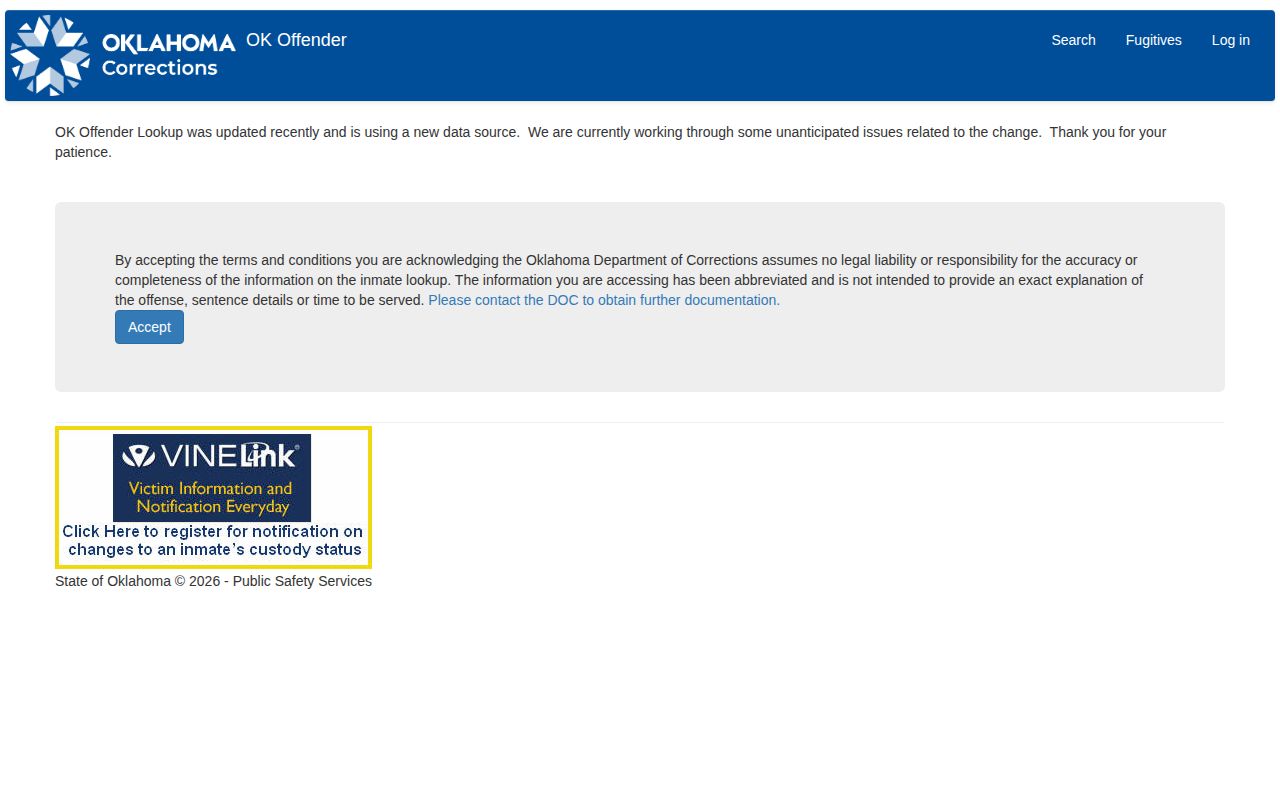
This screen applies to state records, not the GCCJA jail's short local release list.
Grady County 72-Hour Releases
Grady County has a clearly labeled official-vendor release route. The page says Released Last 72hrs and supplies a last-name filter. Its summary gives name, gender, age, and a link to select the record. The detail adds a photo and booking, arresting-agency, charge, bond, and fine fields. It does not show actual release time, reason, or destination. Schedule Release Date is only a scheduled field and was observed as N/A.
The 72-hour label is the only published retention statement. Refresh Results reloads the output but does not promise a real-time update rate. There is no distinct official 24-hour feed, no permanent released archive, and no verified Sheriff mobile app. After a record rolls off, use the jail register and court docket. Recently Booked is an intake view and must not be mistaken for a release list.
The official 72-hour release list illustrates the published window.
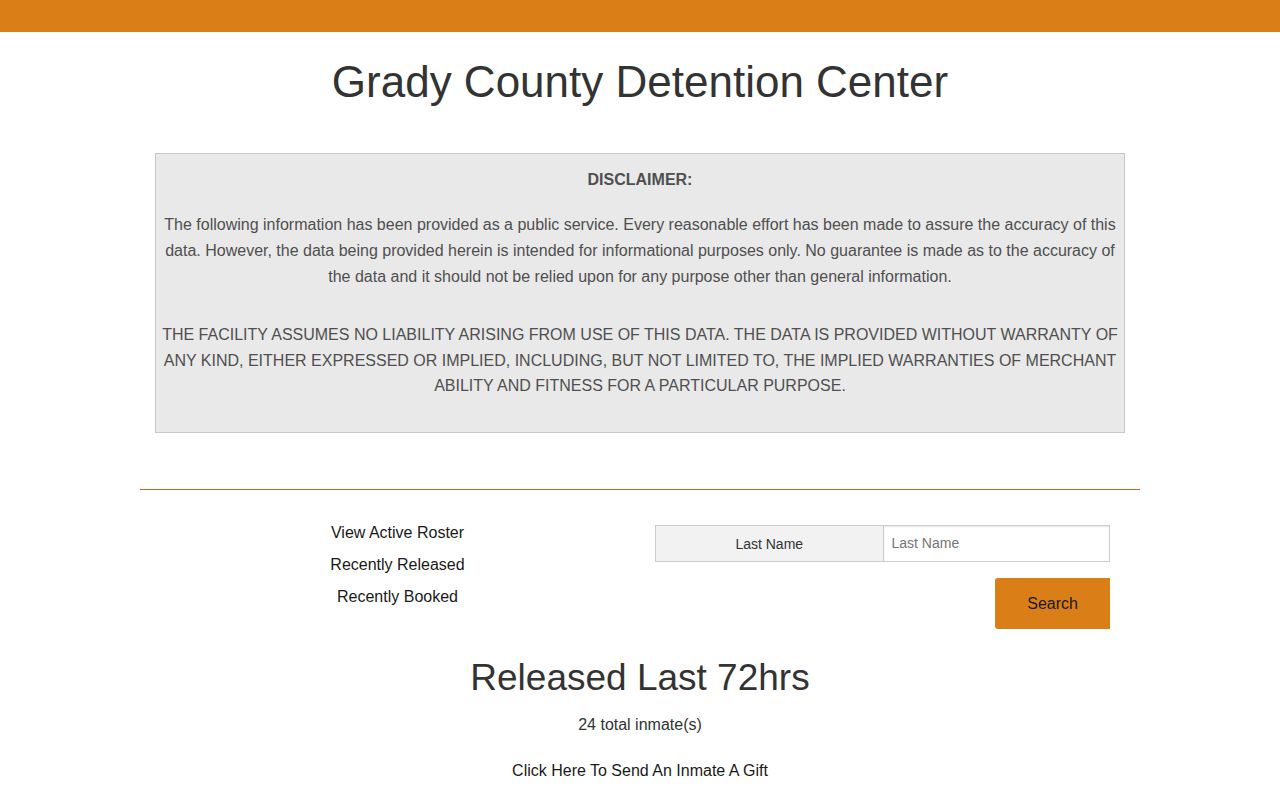
The image shows a discovery tool; the jail discharge record remains the source for manner and destination.
Grady County Release Court Records
The Grady County Court Clerk links both OSCN and ODCR and keeps district-court files for felony, misdemeanor, traffic, juvenile, and other matters. Start with OSCN, choose Grady County, and open the matching case. Bond or release orders, dismissal, plea, judgment and sentence, commitment, warrant recall, and completion entries may explain the legal path long after TCSI's window closes.
The online docket is not the official court record, and it cannot certify when GCCJA acted. A court order may exist before jail processing, or another case may maintain custody. Obtain the Clerk's official file when needed and pair it with the jail-register entry. Municipal ordinance matters may belong to the relevant municipal court instead of the county case system.
Note: Court records explain legal authority, while the jail register documents the facility's actual discharge event.
Grady County Release Supervision
Oklahoma divides parole decisions from field supervision. The Pardon and Parole Board publishes hearing material and results. ODOC Probation and Parole supervises people in the community. A favorable Board action is not the same as physical release, and leaving the Grady jail is not the same as discharge from an ODOC sentence. Confirm the later ODOC placement or release certificate.
ODOC lists a Chickasha Probation and Parole office serving Grady County. A separate Fugitives view can flag absconder status, which means being outside a facility may coexist with a supervision violation. Verification steps and the local reporting-office distinction are covered on the Parole / Probation page.
Grady County Post-Release Support
Resurrection House is a named Chickasha resource at 701 West Colorado Avenue. Its official site describes overnight shelter and a Bible-based life-skills program. It is a voluntary local navigation option, not a custody source, supervision agency, or part of a release record. Contact the organization directly for current services and participation details.
An older ODOT mobility report also described demand-response transit in Grady County, but no current jail pickup arrangement was verified. GCCJA publishes no release door, family waiting zone, or transportation promise. Anyone planning a ride should first ask the detention center for the current exit process and independently verify present transit coverage.
Grady County Federal Release Paths
OK VINE is a free custody-status and notification layer for participating Oklahoma records. Search the exact person, compare the named agency and facility, and register on the matched record for available release, transfer, escape, apprehension, or death alerts. It is not the underlying discharge document and may not keep every historical record. The Attorney General's OK VINE page explains the statewide service.
Grady's facility also has a documented U.S. Marshals detention agreement. That makes federal transport a real possibility without proving a current ICE designation or any named person's status. Sentenced federal custody belongs in the BOP locator, where RELEASED means no longer in BOP custody. Federal pretrial movement may require the federal docket or USMS route. ICE ODLS covers immigration detention and certain recently released records. Each system answers only for its own custody.
Ask Grady County for the receiving agency first. A local roster disappearance can be a federal transport rather than a community release.
Note: The federal agreement proves a custody route exists, but it does not establish any named person's federal status.
Grady County Jail Authority History
County minutes document work around opening the new or expanded jail in 2019, while the State Auditor describes GCCJA's governance. These sources explain why the modern detention center has its own authority and why the Sheriff still supplies public-facing search and records routes. Historical contract capacity, rates, and a live roster count should not be recast as current population facts.
The same building's federal agreement adds a custody layer, not another Grady County facility page. A person held there under local, state-related, or federal authority can leave by different paths. The record must identify the event and destination.
Grady County Custody Source Guide
Use the source whose authority matches the last confirmed custody. A single search cannot cover the county jail, state prison, federal sentence, immigration custody, court action, and community supervision at once.
| Situation | Primary source | What it can establish |
|---|---|---|
| Current Grady booking | TCSI active roster and GCCJA | Live local custody, subject to direct confirmation |
| Recent Grady departure | Released Last 72hrs and jail register | Short-window discovery, then actual discharge details |
| State imprisonment or supervision | ODOC and PPB | State placement, Board action, and official status records |
| Judicial reason for release | OSCN and Court Clerk | Order, disposition, sentence, or warrant history |
| Federal sentence | BOP locator | BOP custody location or RELEASED status |
| Federal pretrial or immigration matter | Federal docket, USMS, or ICE | Agency-specific custody and movement |
| Future custody changes | OK VINE | Alerts from a matched participating record |
Grady County Detention Facility
The Facility Map verified one long-term detention location in the county: Grady County Detention Center. It holds local bookings and has documented federal-use authority. A community release, ODOC commitment, county transfer, or federal movement can all remove a booking from the active set. The correct release path is GCCJA confirmation, the 72-hour list, the jail-register discharge entry, and then the receiving system when the record names one.
Municipal police may book people into this county center, but that does not establish a separate long-term jail for each city. Oklahoma distinguishes short-term holding facilities from county jails. No ODOC prison, BOP institution, standalone ICE center, or juvenile detention center physically in Grady County was verified in the official sweep.